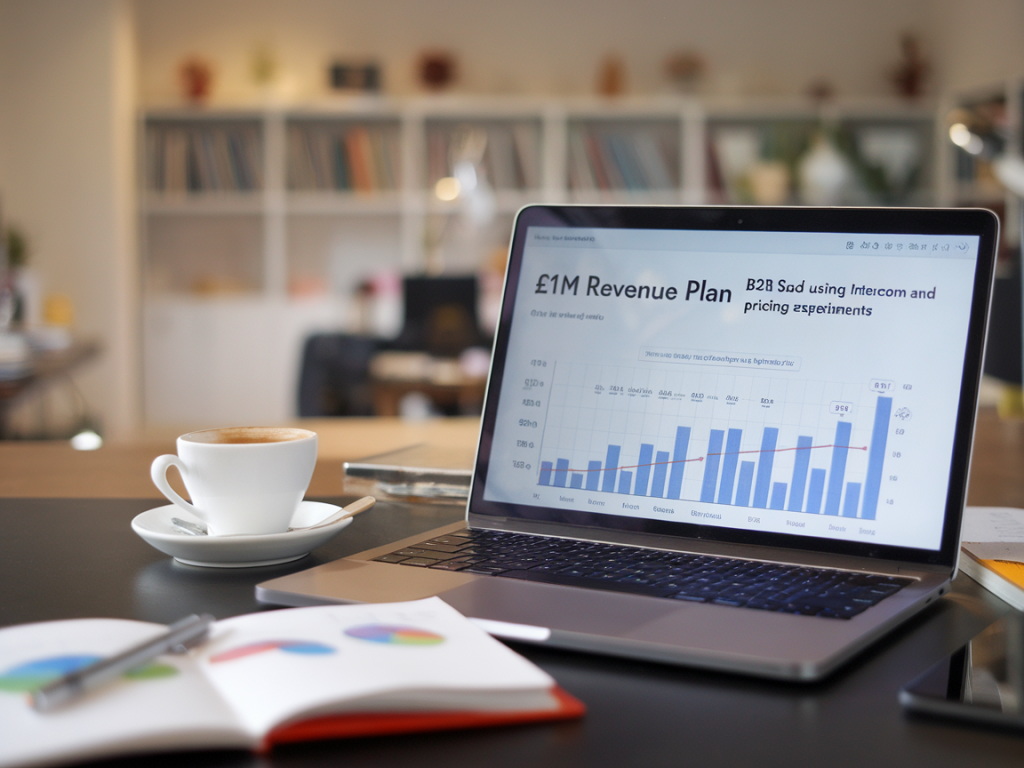
When I set out to build a £1m revenue plan for a B2B SaaS, I didn’t rely on guesswork. I leaned on repeatable processes: building a growth model, instrumenting Intercom for discovery and conversion, and running disciplined pricing experiments. I want to take you through the exact playbook I use—practical, measurable, and focused on what actually moves revenue.
Start with a simple revenue model
The first thing I do is break down £1m into the levers that are under your control. Revenue = Number of customers × Price (average ARR per customer) × Net retention. Translating that into goals gives you clarity:
Example: If your average deal is £10k ARR and you want positive net retention (say 110%), you need roughly 91 customers (£1,000,000 / £11,000). But if churn is high or expansion is limited, you’ll need more new logos. Building the model forces trade-offs: fewer customers at higher price vs. more customers at lower price.
Map the funnel and set acquisition targets
You can’t hit revenue targets without a conversion funnel calibrated to them. I map Conversion Rates across stages: website visit → lead → qualified → trial/demo → closed. Then I reverse-engineer the traffic and leads needed.
If your demo-to-win is 20% and you need 91 customers, you need ~455 demos. If 30% of leads book a demo, you need ~1,517 leads. If your website converts at 3%, that’s ~50,567 monthly visitors over the period—so you can see how acquisition needs scale quickly.
Use Intercom as your revenue engine
I treat Intercom as more than chat. It’s my qualitative research tool, conversion accelerator, onboarding engine, and pricing experiment platform.
One concrete pattern I use: serve different pricing page variants to anonymous visitors based on behavior. If someone engages with Intercom and asks pricing questions, route them to a salesperson with a tailored offer. If they bounce from the pricing page, trigger a lower-cost option or freemium prompt the next visit.
Design pricing experiments that learn fast
Pricing experiments are not about finding the one “perfect” price overnight. They’re about learning elasticity, segmentation, and packaging. I structure experiments to answer specific questions:
My experiments follow a controlled approach: small cohorts, clear metrics, and an observation window long enough for sales cycles to complete. Here’s a simple experiment matrix I often use:
| Variant | Target Segment | Price / Seat or ARR | Hypothesis | Primary Metric |
|---|---|---|---|---|
| Control | SMB (<50) | £200/month | Baseline conversion | Conversion to paid |
| Variant A | SMB with Intercom engagement | £250/month | Higher conversion from engaged users | MRR per cohort |
| Variant B | Mid-market (50–250) | £1,500/month | Will pay premium for advanced support | ACV and close rate |
Evaluate experiments on both acquisition and retention. A higher price that yields short-term revenue but spikes churn is a false positive. I track CAC, payback period, churn, and LTV by cohort so I can see the full picture.
Use packaging, not just price
Price and packaging go together. I test feature bundles, usage caps, and SLA tiers. Here are packaging levers I’ve used successfully:
Packaging reduces friction: you can offer a lower entry price while preserving higher-value plans for customers who need more. This increases new logo volume without undermining enterprise pricing.
Measure the right KPIs and guardrails
For a £1m plan you need both growth metrics and health metrics. Here are the ones I monitor weekly and monthly:
Set guardrails—if churn rises >2 percentage points after a price increase, pause and analyze. If trial-to-paid drops by >10% in a variant, revert and re-run with a different messaging angle.
Operationalize what you learn
Insights are worthless unless they change behaviour. I turn experiment outcomes into playbooks:
For example, when a pricing test showed mid-market customers valued a white-glove onboarding more than a 20% discount, we created a packaged onboarding add-on with a 40% margin—improving both revenue and retention.
Scale with a cadence of experimentation
Reaching £1m ARR is rarely a one-time effort; it’s a rhythm. I run a continuous cycle: hypothesize → run small experiments in Intercom and pricing page variants → measure → standardize winning approaches → scale. That cadence keeps things nimble and data-driven.
If you want, I can share a template for the pricing experiment tracker I use (spreadsheet with cohorts, metrics, and ROIs) and a sample Intercom playbook for qualifying high-intent visitors. Tell me what stage you’re at (early trial, scaling SMB, or targeting mid-market) and I’ll tailor it to your context.