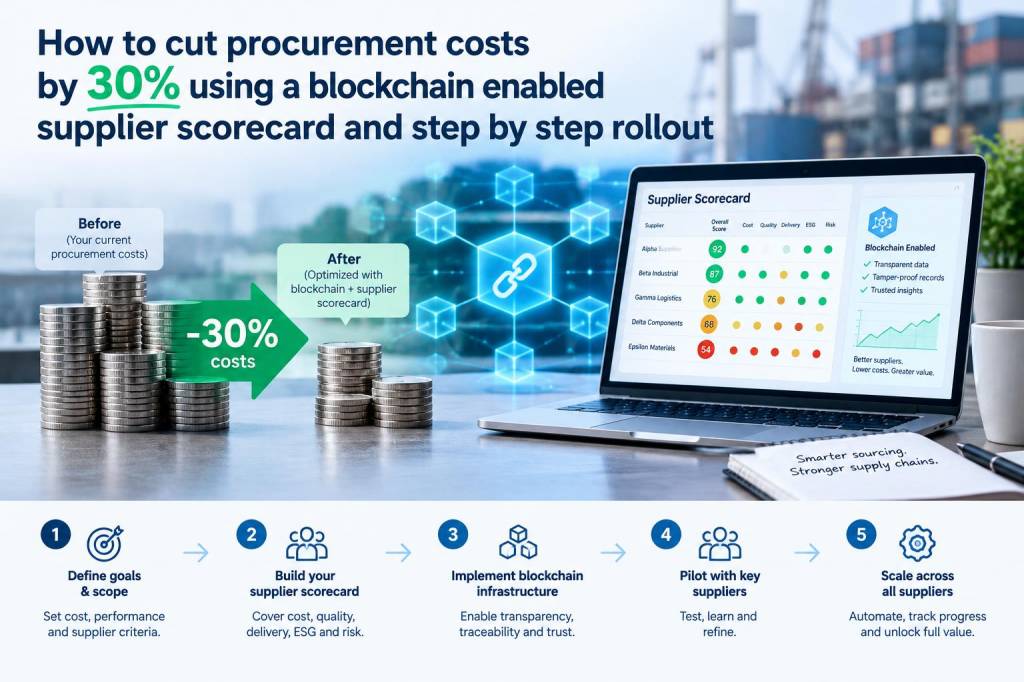
I want to share a practical playbook I've used with clients to cut procurement costs by around 30% using a blockchain-enabled supplier scorecard. This isn't theory — it's a mix of strategy, tech choices and people-focused rollout steps that make the savings real and repeatable. Below I walk you through why a blockchain scorecard works, what metrics to track, a sample scorecard table, and a step-by-step implementation plan that you can adapt to your organisation.
Why a blockchain-enabled supplier scorecard?
Procurement teams are under constant pressure to reduce cost, improve supplier performance and de-risk supply chains. Traditional scorecards and supplier audits often suffer from stale data, lack of auditability, and disputes about the truth. By combining a rigorous supplier scorecard with blockchain’s immutability and smart contracts, you gain:
Trustworthy, auditable data: Every transaction, certificate or performance entry can be time-stamped and tamper-evident.Automated incentives & penalties: Smart contracts can trigger payments, bonuses or holdbacks based on objective score thresholds.Faster dispute resolution: Shared, verifiable records reduce the back-and-forth between buyer and supplier.Better supplier behaviour: When suppliers know metrics are transparent and enforceable, compliance and performance improve.What to measure — core metrics for a procurement scorecard
To hit a 30% cost reduction target, the scorecard must go beyond price. You need to measure factors that materially impact total cost of ownership (TCO) and operational risk. I recommend grouping metrics into four pillars:
Quality & Compliance — defect rate, audit pass rate, certification verifications (ISO, CE).Delivery & Reliability — on-time delivery rate, lead-time variance, fill rate.Cost & Commercial — landed cost variance, invoice accuracy, cost-reduction initiatives implemented.Innovation & Sustainability — number of joint improvement proposals, carbon footprint reporting, circular economy practices.Here’s a simple example of how a blockchain-enabled scorecard might look in a table that lives on-chain for auditability and off-chain for analytics:
| Metric | Weight | Target | On-chain Evidence |
| On-time delivery | 30% | >95% | Delivery timestamps (EDI/API), Proof-of-Delivery hash |
| Defect rate | 25% | <2% | QC reports, lab test hashes |
| Invoice accuracy | 15% | >99% | Invoice hashes vs PO hashes |
| Cost variance | 20% | <5% variance | Price change approvals on-chain |
| Improvement proposals | 10% | ≥1/year | Proposal IDs and outcomes |
How blockchain changes the dynamics
Once these metrics are anchored — by hashing evidence on-chain and storing pointers to documents — you remove ambiguity. A supplier who routinely misses delivery windows but disputes penalties will think twice when the evidence is mutually verifiable. I’ve seen suppliers proactively propose process improvements when they understand rewards and penalties are enforced automatically via smart contracts.
Step-by-step rollout: a pragmatic path to 30% cost reduction
I follow a phased rollout with explicit decision points. That helps manage risk and secure buy-in.
Phase 0 — Discovery & Baseline (4–6 weeks) Map current TCO: identify areas where poor performance drives hidden costs (expedited shipping, rework, stock buffers). Select 5–10 strategic suppliers representing meaningful spend and pain points. Define KPIs, data sources and current baseline performance.Phase 1 — Proof of Value (8–12 weeks) Choose a blockchain framework: for permissioned enterprise use I prefer Hyperledger Fabric or R3 Corda; for broader supplier networks with token incentives, a permissioned Ethereum or Polygon-based approach works. Build a lightweight MVP: scorecard smart contract, on-chain hashes for evidence, and a simple dashboard for buyers and suppliers. Off-the-shelf platforms like IBM Supply Chain or Oracle Blockchain can speed this up if you want enterprise support. Run the MVP with 3–5 suppliers. Use real transactions but limit financial exposure — start with bonus payments, not withholds. Measure impact: track improvements in on-time delivery, price variances, and reductions in emergency freight or returns.Phase 2 — Scale & Automate (3–6 months) Integrate with ERP (SAP/Oracle) and procurement systems via APIs so PO, invoice and GRN events automatically feed into the scorecard. Increase smart contract automation: connect payment triggers to verified milestones for a portion of payments (e.g., early payment discount for >98% on-time). Expand to more suppliers and categories, focusing on high-spend and high-variability areas.Phase 3 — Embed & Optimize (ongoing) Use predictive analytics on the scorecard data to forecast supplier risk and identify negotiation levers. Introduce supplier development programs tied to scorecard outcomes — training, co-investment in process improvements or sustainability initiatives. Continuously refine weights and evidence types based on outcomes and supplier feedback.Change management & supplier engagement
Technology alone won’t deliver 30% savings. You need supplier collaboration and internal alignment. I always run a targeted change plan:
Transparent communication: Explain how metrics will be used, what evidence is required, and how disputes will be resolved.Incentives first: Start with rewards (early payments, preferred supplier status) to build trust before enforcing penalties.Training & onboarding: Provide suppliers with simple tools and templates for generating verifiable evidence (e.g., QR code-enabled delivery notes that feed hashes to the chain).Governance: Create a joint steering committee (buyers + suppliers + IT + legal) to govern the scorecard and smart contract rules.Technology choices and integrations
Pick a stack that matches your supplier demographics and compliance needs:
Permissioned chains (Hyperledger, Corda): Best for enterprise consortia where data confidentiality is important.Permissioned Ethereum / Layer-2 (Polygon, Consensys): Good if you want broader interoperability and easier developer tooling.Oracles & off-chain evidence: Use Chainlink or a trusted oracle to anchor real-world events (e.g., IoT shipment data, customs certificates) to the chain.ERP & procurement integration: Ensure your team or integrator can map PO→delivery→invoice events into the scorecard workflow.KPIs to watch to measure success
To claim a 30% procurement cost reduction, you must track multiple KPIs and attribute savings properly:
Reduction in expedited shipping costs (target 40–60% reduction in expedited spend).Decrease in returns and rework costs.Reduction in invoice dispute cycle time and related working capital freed.Price improvements from stronger negotiation position tied to verified performance data.Supplier-led cost savings and process improvements captured as realised savings.When these components come together — verified performance data, automated incentives, better supplier behaviour, and tighter integration with commercial processes — reducing procurement cost by around 30% becomes an achievable, measurable outcome rather than a stretch goal. If you want, I can help sketch a tailored roadmap for your category or provide a checklist for your technical evaluation.