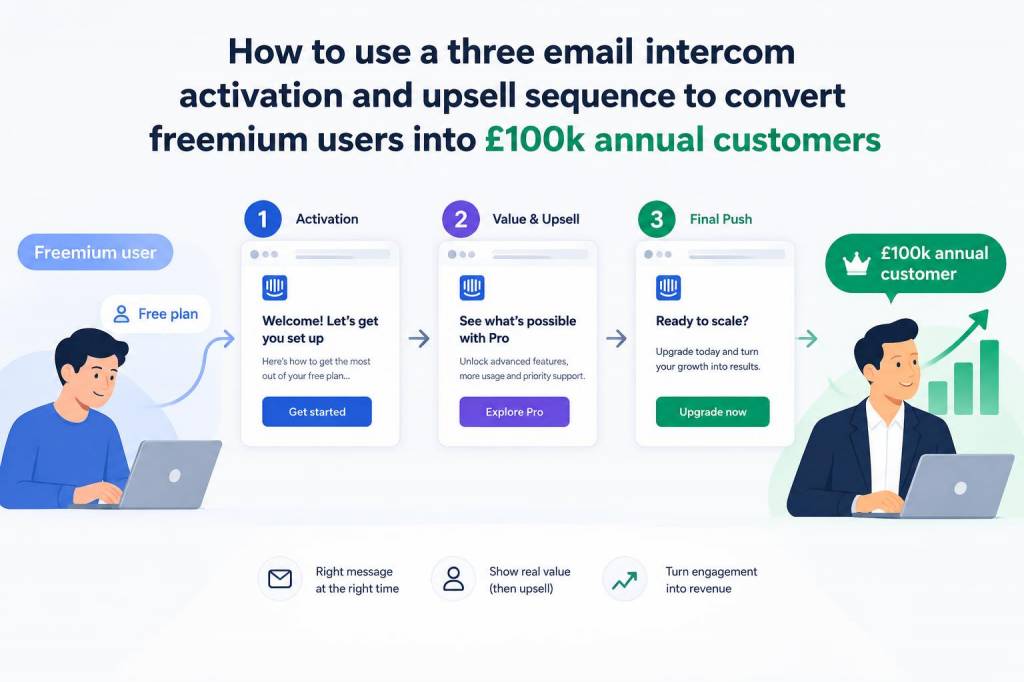
I often get asked how a tiny, tightly focused email sequence can drive massive revenue — not just a trickle of upgrades, but the kind of predictable, scalable income that pushes ARR toward £100k and beyond. Over the years I’ve tested, iterated, and scaled a simple three-email Intercom activation and upsell flow that consistently converts freemium users into high-value customers. Below I’ll walk you through the exact logic, copy approach, timing and metrics I use, and how to measure success.
Why three emails — and why Intercom?
Three emails strike a powerful balance: they’re enough to educate, demonstrate value, and create urgency without overwhelming new users. With Intercom, you have the advantage of context-aware messaging (product events, user segments, behavior triggers). That allows each email to feel personalised rather than generic, which is crucial when the goal is to move users from curiosity to a paid plan worth hundreds or thousands per year.
Who this works for
This sequence is designed for SaaS products with a freemium tier or a generous trial. I’ve used it for marketing automation tools, B2B marketplaces, and data platforms where the typical upgrade jumps a user into a £200–£1,000+/month price bracket. If your LTV of a mid-market customer is north of £3k/year, making a steady stream of those through a repeatable sequence is how you hit that £100k annual target.
High-level strategy
The goal across three emails is simple:
Each email is tied to a behavioural trigger — e.g., sign-up, first successful task, or 7 days of usage with limited engagement — and tailored to the user segment (startup, scale, enterprise). Intercom makes it easy to send conditional messages based on these signals.
What the sequence looks like (timing & content)
| Timing | Trigger | Primary goal | |
|---|---|---|---|
| Activation | 0–24 hours after sign-up | New freemium signup | Get user to complete 1 key action (AHA moment) |
| Value Expansion | 48–72 hours after activation OR 3 days after no activation | Completed core action or still inactive | Show paid features that scale the core value |
| Urgency + Social Proof | 7–10 days | Used free plan > X days or hit usage cap | Create urgency, reduce friction to upgrade |
Activation email: the AHA moment
First impressions matter. My activation email does three things: congratulate the user, remind them what to do to reach the “AHA” moment, and give an ultra-easy next step. Keep it personal, short, and actionable.
Subject line examples: “One step to see your first [result]” or “Welcome — here’s how to get your first [metric] in 5 minutes”.
Key copy structure:
Example CTA: “Click here to import your first list — it takes 90s.” The more frictionless the task, the higher the completion rate.
Value expansion: show the multiplier effect
Once a user has tasted the product’s value, they’re primed to learn how paid features multiply that value. This email leverages data or a product demo to make the trade-off obvious.
Subject line examples: “What top teams do next with [product]” or “Scale your results: more reports, fewer hours”
Core elements:
Urgency + social proof: remove friction and nudge
This is where you shorten the path to conversion. Use scarcity wisely (limited seats for concierge onboarding, a capped discount), and combine it with real social proof.
Subject line examples: “Upgrade to unlock [feature] — limited slots for free onboarding” or “Customers like [well-known brand] see X in 30 days”
Elements that convert:
Measuring what matters
To know if this sequence can scale you to £100k ARR, track these KPIs:
Example math: if 10,000 freemium signups/year, activation 25% (2,500), upgrade rate 4% (100 conversions), and average first-year revenue £1,000 → £100k ARR. Small improvements in activation or upgrade rate have a huge multiplier effect.
Operational tips and pitfalls
Personalisation is about context, not fluff. Don’t just insert a name — reference the action they took. Use Intercom’s event properties to show a relevant stat (e.g., “You imported 320 contacts — here’s how to turn them into customers”).
A few things I learned the hard way:
Finally, integrate sales and product signals. Pass upgrade intent to a sales queue for high-value accounts and feed behaviour back into product to improve the AHA moment. When product, marketing and sales speak the same language, a three-email sequence becomes a revenue engine, not just a campaign.