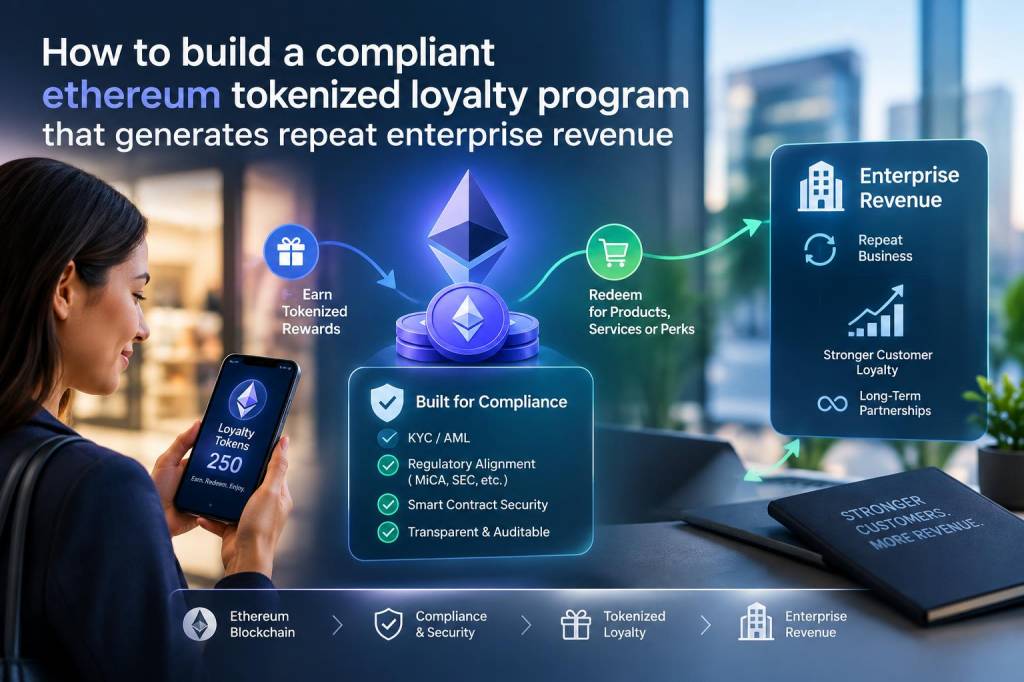
I’ve worked with brands that wanted the buzz of crypto without the headaches of regulatory risk or poor user experience. Building a tokenized loyalty program on Ethereum can deliver genuine, repeat enterprise revenue—but only if you design it to be compliant, usable, and tightly integrated with existing sales and CRM workflows. Below I share a practical playbook I use with clients: legal guardrails, technical choices, tokenomics, UX, and the integrations that turn token engagement into recurring enterprise income.
Why tokenize loyalty—and what "compliant" really means
Tokenized loyalty gives customers digital assets they can hold, earn, transfer, or redeem. Those tokens can boost retention (repeat purchases), increase wallet-based engagement, and create secondary market value. But tokenization also raises questions: Is the token a security? Does issuing it trigger AML/KYC obligations? How do we respect GDPR?
For me, "compliant" means three things:
- Legal classification is clear—consult counsel so the token is structured as a utility (access, discounts, services) rather than an investment contract unless you intend securities regulation.
- AML/KYC and sanctions screening are in place for account creation and high-value redemptions.
- Data privacy and accounting/tax reporting fit enterprise standards (e.g., VAT, corporate revenue recognition).
High-level architecture I recommend
I usually separate the on-chain token from the user experience layer:
- Off-chain loyalty engine: a centralized database (or permissioned ledger) stores balances, business rules, and redemptions. This lets you implement enterprise controls and accounting rules.
- On-chain token: an ERC-20 / ERC-721 / ERC-1155 token on Ethereum (or L2) that represents tradable loyalty units for customers who opt in.
- Bridging layer: smart contracts and APIs that synchronize balances between off-chain and on-chain systems, with cryptographic proofs for auditability.
This hybrid model gives enterprises control for compliance and customer support while offering the benefits of blockchain for marketable loyalty tokens.
Choosing the right token standard and chain
The token standard depends on how you want tokens to behave:
- ERC-20 — fungible points/credits.
- ERC-721 — unique rewards, VIP passes, or limited NFTs tied to experiences.
- ERC-1155 — hybrid: fungible + non-fungible in the same contract (useful for diverse reward catalogs).
For enterprise scale and customer UX, I favor L2s like Polygon, Optimism, or Arbitrum to keep gas fees low. A Layer 2 reduces friction for consumer interactions and can be bridged to mainnet for long-term custody or liquidity. Consider gasless flows using meta-transactions or account abstraction (ERC-4337) to onboard non-crypto-native customers without forcing wallet management upfront.
Tokenomics that generate repeat revenue
Design token mechanics to tie back to lifetime value:
- Reward earn rates: tie tokens to recurring behaviors—subscription renewals, repeat purchases, referrals.
- Redemption value and tiers: give clear, predictable value for redemptions (e.g., 100 tokens = £5 discount).
- Staking and vesting: encourage holding by offering bonus rewards or exclusive enterprise features for staked tokens.
- Burn and scarcity: burn tokens on redemption or for special access to create controlled scarcity—but avoid artificial restrictions that harm user trust.
One approach I’ve used: give small on-chain tokens for referrals and larger off-chain credits for renewals. The on-chain tokens are tradable badges that increase customer lifetime value by increasing engagement, while the off-chain credits are used for direct discounts that feed immediate revenue.
Compliance checklist
- Engage legal counsel experienced in crypto and UK/EU regulation (FCA, MiCA) before launch.
- Design token as utility to avoid securities classification unless you accept regulated issuance.
- Implement KYC/AML for accounts that convert tokens to fiat or high-value transfers; screen against sanctions lists.
- Ensure GDPR compliance—obtain consent for wallet linking and data processing, enable deletion/portability requests when feasible.
- Consult tax advisors for VAT, corporate tax, and revenue recognition treatment of tokens and redemptions.
- Plan for auditability—use on-chain proofs and off-chain logs so auditors can reconcile balances.
Security and trust: smart contract and operational practices
Security is non-negotiable for enterprise customers. I always recommend:
- Use battle-tested libraries like OpenZeppelin for contracts.
- Perform at least two independent security audits before mainnet/L2 deployment.
- Implement multi-sig wallets (Gnosis Safe) for treasury and admin operations.
- Rate-limit minting and burning operations and introduce emergency pause functionality.
Customer experience and adoption
Most enterprises fail because they make crypto UX too hard. My rules for adoption:
- Onboard customers via email/SSO and issue custodial wallets initially if needed to reduce friction.
- Offer option to migrate to self-custody for advanced users (MetaMask, WalletConnect).
- Provide clear redemption mechanics and a dashboard showing token value in fiat equivalence.
- Use notifications (email/SMS/in-app) for token activity and promotional offers tied to token holdings.
Integrations that turn tokens into recurring revenue
The real business value comes from integrating tokens into sales and marketing systems:
- CRM integration (HubSpot, Salesforce) to trigger token awards on renewals and upsells.
- Payments integration (Stripe checkout) for token redemptions that convert to discounts or invoice credits.
- Marketing automation for drip campaigns targeting token holders with tailored offers.
- Analytics pipelines feeding dashboards so revenue teams can measure cohort LTV uplift from token programs.
Implementation phases
| Phase | Key deliverables | Timeframe |
|---|---|---|
| Pilot | Legal opinion, off-chain engine MVP, token design, limited user group | 6–10 weeks |
| Launch | Smart contract deployment on L2, wallet onboarding, CRM & payments integration | 8–12 weeks |
| Scale | Security audits, marketing ramp, staking & secondary market support | Ongoing |
Tools and partners I trust
Some platforms and tools I often recommend: OpenZeppelin (contracts), Chainlink (oracles), Gnosis Safe (treasury), Polygon/Optimism (L2), Jalapeno/Modular or third-party custodians for compliance-enabled wallets, and analytics tools that tie on-chain events back to HubSpot or Salesforce. For payment rails, Stripe + a token-to-credit reconciliation layer works well.
If you’re building a program for an enterprise, I can walk you through a staged approach: legal framing, an off-chain loyalty core, an L2 token with gasless UX, and CRM + payment integrations that create measurable uplift in repeat revenue. I’ve seen tokenized loyalty shift customer behaviour when it’s compliant, simple, and tightly aligned to business KPIs—and that’s the combination I aim for every time.