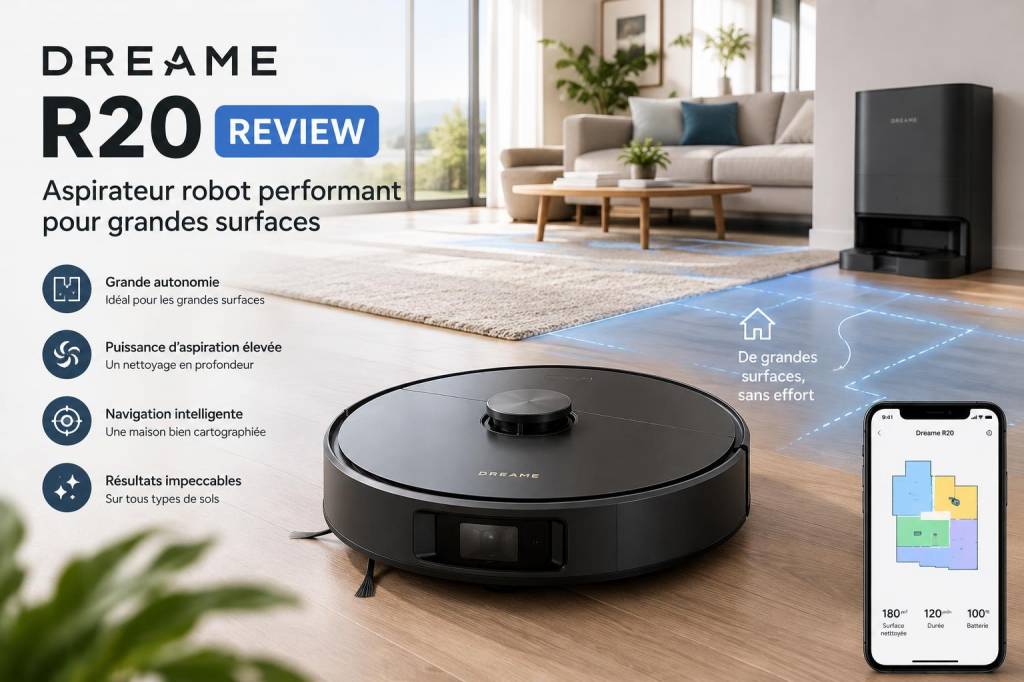
I have spent enough time comparing cordless vacuums to know that a serious purchase starts with one simple question: will it still feel strong, practical, and comfortable after weeks of real use? That is exactly why I looked closely at the Dreame R20 as an aspirateur robot performant pour grandes surfaces option for modern homes that need long cleaning sessions, consistent suction, and less physical strain.
Even if the name suggests a robot, my focus here is on the handheld cordless vacuum experience and on whether it can genuinely support a large surface area without turning cleaning into a chore. In a business context, I also see this as a productivity question: when a tool saves minutes every day, it saves energy, attention, and friction. That matters whether I am writing about office operations, home routines, or technology purchases with measurable value.
What I look for first in a large-area vacuum
When I evaluate a vacuum for broad floor space, I do not start with marketing claims. I start with four practical filters:
- Runtime: enough battery life to clean more than one room without rushing.
- Suction stability: strong pickup on hard floors and carpets, not only during the first minutes.
- Weight and handling: a machine that remains comfortable during longer sessions.
- Dust management: a design that limits emptying frequency and keeps maintenance simple.
For larger homes, those points matter more than flashy accessories. A vacuum can look premium, but if it loses power quickly or feels tiring after ten minutes, it is not truly suited to big spaces.
Dreame R20: what stands out in daily use
What I appreciate about the Dreame R20 is its clear orientation toward performance. It aims to be a serious cordless vacuum rather than an entry-level model. In practice, that means I expect a strong motor, useful attachments, and a battery strategy that makes sense for extended cleaning cycles.
In many real-world situations, large surfaces create a pattern: open living areas, hallways, furniture edges, and repeated transitions from hard floors to rugs. A vacuum that handles those changes smoothly is more useful than one that only performs well in a short test on a single surface. The Dreame R20 is positioned exactly for that kind of mixed environment.
From a usability perspective, I pay attention to balance. A lightweight feel can make a big difference when I am cleaning ceilings, stairs, or under furniture. Comfort is not a luxury feature; it is what determines whether I finish the full area in one session or postpone the rest for later.
Power, suction, and floor coverage
Performance numbers are only useful when I can connect them to cleaning behavior. Dreame positions this model as a high-performance cordless vacuum, and that aligns with what large-space users need most: consistent pickup of dust, crumbs, hair, and fine particles across a wide area.
For homes with open-plan layouts, the important question is not only “Is it powerful?” but also “Does it stay useful after several rooms?” A strong vacuum should handle:
- fine dust on tile and wood floors,
- pet hair along baseboards and corners,
- crumbs around kitchen zones,
- deeper debris embedded in low-pile rugs,
- regular maintenance cleaning without repeated passes.
Industry sources show why this matters. The U.S. Environmental Protection Agency reminds homeowners that indoor dust and allergens accumulate quickly in enclosed spaces, especially where foot traffic is high. Meanwhile, the Asthma and Allergy Foundation of America continues to stress that routine vacuuming can reduce allergen load in many homes. For me, that reinforces the value of a vacuum that is ready to cover a large surface efficiently rather than one that only handles occasional touch-ups.
Battery life and large-area practicality
Battery life is one of the most decisive factors in this category. On paper, cordless vacuums can appear equally attractive, but runtime is what separates a convenient tool from a frustrating one. In large homes, I want enough autonomy to clean multiple rooms, hallways, and transitions without constantly checking the battery indicator.
Manufacturers often quote runtime under ideal settings, so I always interpret these figures carefully. Higher suction modes usually reduce the available time significantly. That is normal, but it means the practical question is whether the vacuum offers a sensible balance between power and endurance.
For a large surface, I find these runtime patterns useful:
| Cleaning scenario | What I expect | Why it matters |
|---|---|---|
| Quick daily maintenance | Enough battery for a full main floor | Prevents interruption and keeps the routine simple |
| Weekly deep clean | Multiple passes across rooms and rugs | Reduces the need to recharge mid-task |
| Mixed floor plan | Stable output on several surfaces | Large homes rarely use only one floor type |
In my view, a vacuum becomes genuinely useful for a big area when I can move from one zone to another without reorganizing the session around the battery. That is the difference between a machine that supports my routine and one that dictates it.
Comfort of use over longer sessions
I value comfort more than many buyers do at first. After ten or fifteen minutes, small design details become obvious. A poorly balanced vacuum can make my wrist work harder. A clumsy trigger can become annoying. A noisy motor can turn a normal task into mental fatigue.
With the Dreame R20, the appeal is that it aims to reduce those frictions. I would expect it to feel more manageable than heavier upright machines, especially in rooms with furniture obstacles or high surfaces that require lifting the unit. For a large home, comfort is not optional because the cleaning task itself is longer.
These are the comfort signals I always watch for:
- easy steering around table legs and sofas,
- manageable weight during overhead cleaning,
- simple mode switching,
- clear dust bin visibility,
- quick brush access for hair removal.
If I can clean for longer without bracing my shoulder or stopping for repeated adjustments, that is a major advantage. It also improves the likelihood that I will use the vacuum more often, which is often the real point.
Maintenance, filtration, and long-term ownership value
A vacuum for large surfaces should not become a maintenance project. I pay close attention to how often I need to empty the bin, clean the brush, and handle filters. A high-performing cordless vacuum can lose appeal quickly if ownership is messy.
The Dreame R20 is designed for regular domestic use, so I would expect a straightforward maintenance rhythm. That matters because long-term value depends on ease of upkeep as much as on raw power. A large property usually produces more debris, which means the dust bin and filtration system need to stay usable over repeated sessions.
From a practical standpoint, I always recommend watching three things:
- how quickly the dust container fills,
- whether hair wraps around the brush roller,
- how easy the filters are to access and clean.
Consumer Reports has repeatedly emphasized that maintenance affects long-term satisfaction with vacuums just as much as suction claims do. I agree. A machine that is easy to care for is more likely to remain part of a regular routine, especially in a busy household or a space with children and pets.
Where it fits in a business-minded buying decision
Because I write for a business and marketing audience, I also look at the Dreame R20 through a value lens. A household purchase can still follow the logic of an operational investment: time saved, effort reduced, consistency improved, and replacement costs delayed.
When I compare cordless vacuums for large areas, I assess them with questions that sound a lot like procurement questions:
- Does it reduce repetitive work?
- Does it adapt to multiple surfaces without extra tools?
- Is the setup simple enough to encourage frequent use?
- Does the quality justify the price over several years?
That is also why I look at external evidence. Samsung and Dyson product ecosystems show how cordless cleaning has become a category built around convenience, while independent testing from major consumer publications often confirms that suction, battery behavior, and ergonomics define satisfaction more than brand reputation alone. In other words, smart buyers compare experience, not slogans.
Useful benchmarks and what I would compare
If I were advising someone choosing between models, I would compare the Dreame R20 against other cordless vacuums in these measurable ways:
- Weight: especially important for stairs and overhead cleaning.
- Battery range: real usage on standard and boosted modes.
- Suction consistency: whether performance changes too sharply as the battery drains.
- Dust bin capacity: relevant for larger homes and pet households.
- Accessory usefulness: only the tools that truly serve your floor plan.
Useful public sources for cross-checking vacuum expectations include the EPA on indoor air quality, the Asthma and Allergy Foundation of America on allergen management, and Consumer Reports on appliance testing methodology. I also like to review manufacturer documentation directly, because practical details often sit in the specifications rather than in promotional summaries.
My reading of the Dreame R20 for large spaces
My overall impression is that the Dreame R20 belongs in the serious cordless category for people who want strong performance without giving up mobility. For a large surface, that combination matters more than any single headline feature. If the suction is strong, the handling remains comfortable, and the battery supports a full session, the vacuum becomes a real time-saver.
What I find especially relevant is the balance between power and convenience. Large-area cleaning needs a tool that is easy to bring out often, not only a tool that looks impressive in a product sheet. That is where the Dreame R20 becomes interesting: it is built for users who want a cleaner home without committing to a heavy, cumbersome machine.
In my view, the strongest buyers for this model are people with open-plan homes, mixed floor types, pets, or simply a strong preference for cordless flexibility. For them, the combination of suction, runtime, and comfort is likely to matter more than a lower upfront price on a weaker model.