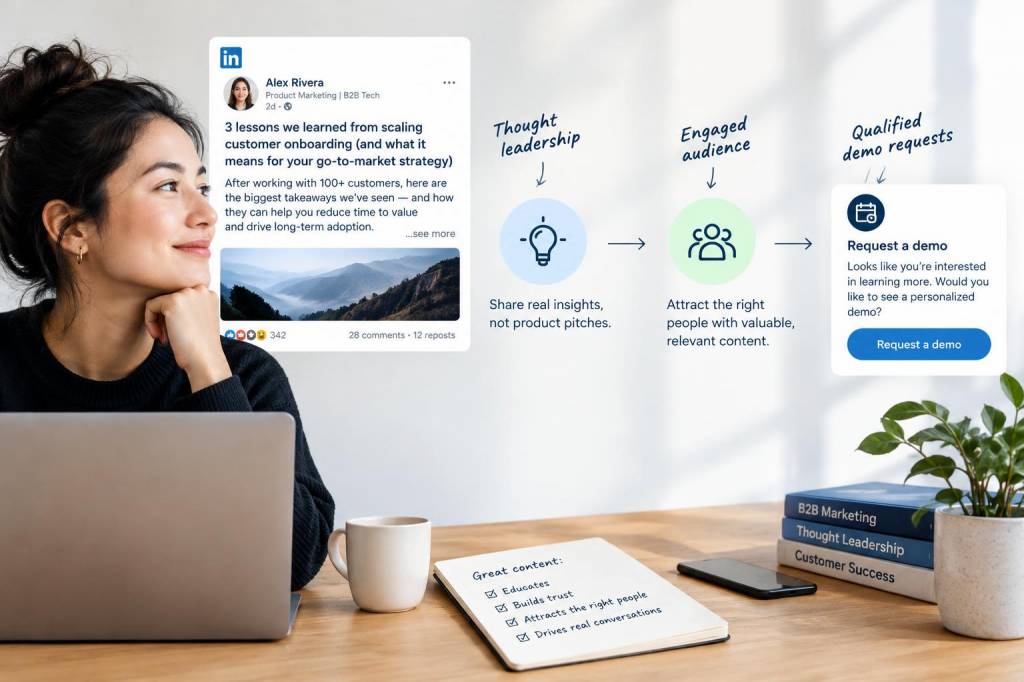
I have learned that LinkedIn works best for demand generation when I stop treating it like a place to “post content” and start treating it like a place to earn trust in public. When I share ideas that help people do their jobs better, I do not need to push for a demo in every post. In fact, the more I try to force a conversion, the less likely it is to happen. What actually works is a steady pattern: useful thinking, clear positioning, proof of understanding, and a path that feels natural when someone is ready to learn more.
That is why I think of LinkedIn thought leadership as a relationship engine, not a megaphone. If my posts sound like a sales pitch, people scroll past. If my posts sound like they were written to impress rather than help, people may engage, but they do not raise their hand. My goal is different. I want my content to attract the right people, filter out the wrong ones, and make a demo request feel like the logical next step rather than a forced ask.
Start with a problem I understand deeply
The strongest LinkedIn content I publish usually begins with a problem that my audience already feels. Not a broad industry theme, but a specific frustration that shows up in their week. A marketing leader may be tired of low-quality inbound leads. A founder may be struggling to explain value without sounding generic. A sales team may have plenty of activity and not enough real opportunities. When I speak directly to a painful and familiar problem, I earn attention because people recognize themselves in it.
I avoid opening with product language. Instead, I start with something like: a pattern I have noticed, a mistake I keep seeing, a belief I used to hold, or a question I wish more teams asked earlier. This gives me room to sound like a practitioner, not a promoter. Once I have that attention, I can add perspective that is practical, specific, and grounded in experience.
For example, instead of saying, “Our platform improves pipeline efficiency,” I might say, “I keep seeing teams lose qualified demand because they ask for too much commitment too early.” That sentence is more useful, more human, and more likely to invite a real conversation.
Use experience, not slogans
People do not trust empty confidence. They trust evidence of experience. I build my credibility by sharing what I have observed in real situations, what changed my thinking, and what results followed. This does not mean I need to expose confidential details or write case studies every time. It means I should sound like someone who has actually seen the problem up close.
I often include small details that make a post feel real:
- A pattern that showed up repeatedly across several accounts
- A question a prospect asked that revealed a deeper issue
- An assumption that proved wrong after testing
- A simple framework that helped a team make a decision faster
Those details matter because they separate thoughtful commentary from generic industry noise. When readers see that I understand the mechanics behind the problem, they become more open to hearing about a solution. That openness is what eventually turns into a qualified demo request.
Write for belief, not applause
Not every post needs broad engagement. Some of my best-performing posts do not go viral, but they attract exactly the right people. I care more about attracting decision-makers with real pain than about collecting likes from people who will never buy. This changes the way I write.
I am not trying to please everyone. I am trying to resonate with a narrow group who may be evaluating a category, facing a moment of change, or looking for a better way to solve a familiar problem. That means I can be more direct, more opinionated, and more selective about what I say.
A strong thought leadership post should help a reader think, “This person understands my world,” not “This person is trying to sell me something.” When that happens, a demo request feels like a natural continuation of trust.
Make every post useful on its own
I never rely on a post to do one thing only. If I want it to support demo requests, it still needs to deliver value even if someone never clicks anything. That means I build each post around a clear insight, a practical takeaway, or a useful shift in perspective.
There are several formats that work well for me:
- A short story with a lesson drawn from it
- A common mistake and what I would do instead
- A framework that helps people diagnose a challenge
- A contrarian view that challenges a widely accepted habit
- A breakdown of what successful teams do differently
If the reader gets value immediately, trust rises. If trust rises, curiosity follows. And if curiosity is strong enough, the reader is far more willing to explore a demo without feeling pressured.
Let curiosity do the selling
I have found that one of the most effective ways to generate qualified interest is to create a gap between what people know and what they want to know next. I do not need to explain everything in the post. In fact, I should not. I want to leave enough unresolved that the right reader feels compelled to ask questions.
That does not mean being vague. It means being selective. I may share a useful framework, but not every implementation detail. I may describe a result, but not every lever behind it. I may explain the problem, but not every step of the solution. This gives me room to say, in a calm and non-pushy way, that I am happy to show how the approach works in practice.
When I make the next step feel like an exploration rather than a pitch, more people respond. They are not being sold to. They are being invited.
Use soft calls to action that match intent
Hard-selling in LinkedIn posts usually damages trust. I prefer soft calls to action that match the level of interest a reader may have after consuming the content. Some posts deserve no call to action at all. Others can end with a simple question, a reflection, or an open invitation to continue the conversation.
Here are some calls to action I often use:
- If this problem sounds familiar, I am happy to share what I have seen work.
- If you are dealing with this challenge, I can walk through the approach I use.
- If you want a practical example, I can send one.
- If this is a priority for your team, I would be glad to compare notes.
These phrases work because they respect timing. They do not assume a purchase. They open a door. Qualified buyers usually appreciate that tone because they are already evaluating options and do not want to be rushed.
Build a bridge from post to demo
I think of my content and my demo flow as one connected experience. If a post sparks interest, the next step should feel consistent with the promise of the post. That means the landing page, profile, pinned post, and direct message should all reinforce the same value proposition. If the post is about reducing wasted effort in outreach, the demo should immediately show that reality in action.
I pay attention to friction points. If someone has to guess what happens next, I lose them. If they click and land on a page that feels too generic, I lose them. If my profile bio is vague, I lose them. Every touchpoint should answer a simple question: “Why should I keep going?”
A strong bridge often includes:
- A clear description of who I help
- A specific pain point I address
- A visible proof point or result
- A simple next step that does not feel risky
Measure interest signals, not just direct conversions
Some of the most valuable leads I have received from LinkedIn never clicked a link right away. They commented, saved the post, viewed my profile, or sent a message days later. That is why I do not judge performance only by immediate demo requests. I watch for signals that indicate real interest.
| Signal | What it may mean | My next move |
| Profile visits after a post | Curiosity about credibility or offer | Keep profile messaging clear and relevant |
| Meaningful comments | Reader is thinking about the issue seriously | Reply with substance and continue the conversation |
| Direct messages | Reader wants more detail or context | Offer a helpful, low-pressure next step |
| Repeat engagement | Trust is building over time | Maintain consistency and relevance |
When I track these signals, I get a better sense of which posts attract real buying interest. That helps me refine my message and improve the quality of demo requests over time.
Keep my tone confident, calm, and specific
The tone I use matters as much as the message itself. If I sound desperate, exaggerated, or overly enthusiastic, readers pull away. If I sound calm, informed, and precise, they lean in. I have learned that restraint is often more persuasive than intensity.
That is especially true when I mention my offer. I never need to oversell outcomes or promise transformation in dramatic language. I can simply explain what I help people do, why it matters, and what a conversation would cover. Specificity builds credibility. Calm confidence builds trust. Together, they make a demo request feel earned.
When I write this way, LinkedIn becomes much more than a content channel. It becomes a place where ideas create momentum, trust compounds over time, and qualified buyers feel comfortable starting a conversation because I have already shown them that I understand their world.