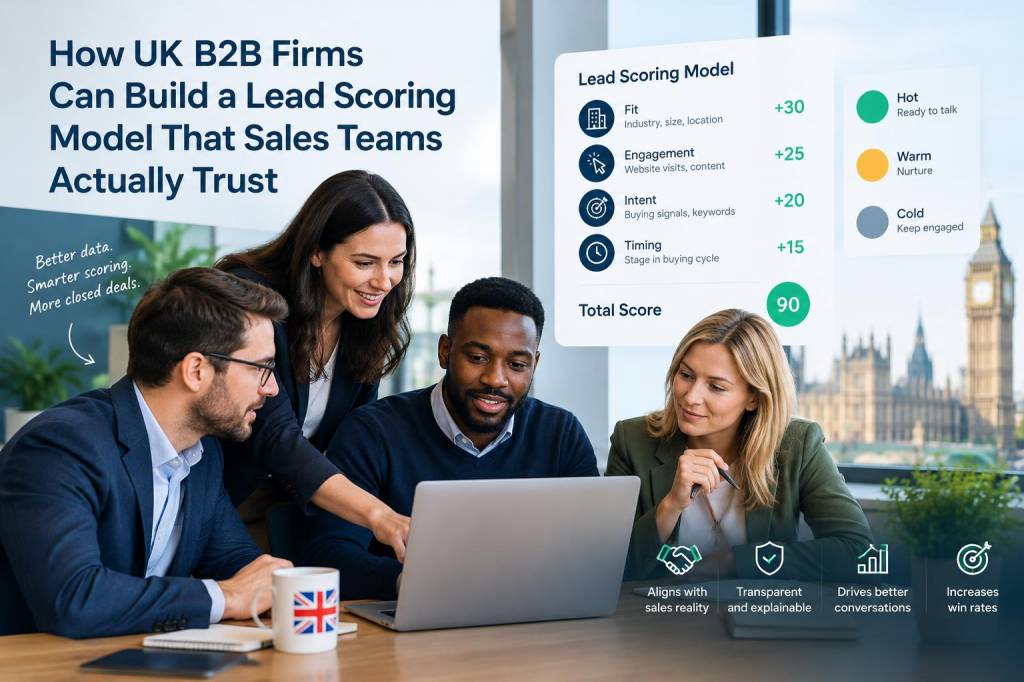
I have seen too many lead scoring models fail for the same reason: marketing builds a neat system, hands it over to sales, and expects everyone to trust it without asking whether it reflects real buying behavior. In UK B2B firms, that gap between a polished score and a sales rep’s lived experience can become costly fast. If sales people do not trust the model, they ignore it. When they ignore it, even a clever scoring framework becomes little more than a dashboard ornament.
My approach has always been simple: a lead scoring model only works when it mirrors what sales already believes, then improves on it with evidence. That means I do not start with software. I start with conversations, data review, and a shared definition of what a good opportunity actually looks like.
What I mean by trust in a lead scoring model
When I say trust, I do not mean blind faith in a number. I mean that a sales rep can look at a score and think, “Yes, this feels right, and I can see why this lead is here.” That confidence matters because sales teams work quickly. If a score is mysterious, inconsistent, or full of signals they do not respect, they will fall back on instinct alone.
Trust grows when three things are true. First, the model is built from signals that genuinely relate to conversion. Second, sales can understand those signals without needing a data scientist in every meeting. Third, the model keeps proving itself in real pipeline performance.
In practice, I have found that trust is less about mathematical sophistication and more about credibility. A simple model that accurately reflects reality will beat a complex one that nobody believes.
I begin by aligning on what a qualified lead really means
Before I score anything, I ask sales and marketing to agree on a shared definition of qualification. This sounds basic, yet it is where many systems start to wobble. One team may care about title and company size, while another cares about urgency, budget, or a specific product need. If those ideas are not aligned, scoring becomes political instead of practical.
I usually ask questions like these:
- Which attributes appear most often in closed-won deals?
- Which behaviours usually show up before a demo request?
- Which signals are interesting but not actually predictive?
- Which leads look active but rarely convert?
This conversation matters because a good scoring model should reflect revenue patterns, not internal assumptions. I prefer to use historical deals as my starting point. If the data shows that certain industries, company sizes, or engagement patterns convert more often, that becomes the first layer of the model.
I separate demographic fit from behavioural intent
One of my strongest preferences is to score fit and intent separately. That distinction makes the model easier to understand and far more useful for sales.
Fit tells me whether a company matches my ideal customer profile. This may include geography, sector, company size, revenue range, technology stack, or job function. A poor fit can still show interest, but it may not be a priority for sales.
Intent tells me whether the lead is actively engaging. This may include website visits, content downloads, pricing page views, webinar attendance, email engagement, return visits, or form submissions. A high-intent lead with weak fit may still deserve attention, but perhaps from a nurture stream rather than immediate outreach.
When I keep these categories separate, sales can see whether a lead is valuable because it is a strong match, because it is highly active, or because both are true. That clarity helps them trust the system far more than a single blended number ever could.
I use sales input to decide which signals matter
If I want a model that sales people respect, I involve them early. I do not ask them to approve a finished scoring sheet. I ask them to help me shape it. That makes a huge difference.
I like to run working sessions with top performers and ask them which signals usually appear before a meaningful conversation. Often, they will point out details that marketing data alone would miss. For example, a repeat visit to a product comparison page may matter more than five generic blog reads. A visit from a decision-maker at a target account may matter more than multiple visits from an intern doing research.
Sales teams also help me identify negative signals. Some behaviours look busy but do not indicate readiness. For example:
- Very short site sessions with no return visit
- Student, competitor, or irrelevant email domains
- Job seekers browsing careers pages only
- Repeated activity from the same account with no real buying pattern
When I include these exclusions, the model feels smarter to sales because it avoids rewarding noise.
I keep scoring rules transparent and easy to explain
Nothing destroys trust faster than a scoring system that feels like a black box. I want sales to be able to answer a simple question: why does this lead have this score?
That means I avoid overly clever point logic. I prefer scoring rules that are visible, documented, and easy to audit. If a pricing page visit is worth 20 points, I want everyone to know why. If an executive title adds value, I want the rationale written down. If webinar attendance matters only when paired with a target industry, I want that logic reflected clearly.
I also like to name score components in a human way. Instead of hiding everything inside one opaque number, I separate it into meaningful buckets such as profile match, engagement depth, and buying behaviour. That structure makes the model easier to discuss in sales meetings and easier to improve later.
I test the model against real pipeline outcomes
A lead scoring model should earn trust with proof, not promises. Once I build a first version, I compare it against actual outcomes. I want to know whether high-scoring leads really move faster, convert more often, or create better pipeline quality than low-scoring ones.
I usually review questions like these:
- Do high-score leads book more meetings?
- Do they progress through stages more quickly?
- Do they produce higher opportunity creation rates?
- Do they close at a higher rate than lower-score leads?
If the answer is no, I adjust the model. Sometimes I remove weak signals. Sometimes I reduce the weight of vanity engagement. Sometimes I discover that a strong predictor I overlooked should carry more influence. I treat the model as a living system, not a one-time project.
This is where many firms in the UK miss an opportunity. They launch a scoring model, then leave it untouched for a year. Market conditions shift, campaigns change, buying behaviour evolves, and the model slowly drifts away from reality. Sales notices this drift long before leadership does.
I show sales where the model helps them win time
Sales trust improves when the model saves them time instead of creating extra admin. I frame scoring as a prioritisation tool, not a judgment machine. It should help reps decide where to focus first.
For example, I may set clear actions such as:
- High-fit and high-intent leads go to immediate outreach
- High-fit and low-intent leads go into light nurture with account monitoring
- Low-fit and high-intent leads go into tailored qualification review
- Low-fit and low-intent leads stay in long-term nurture
This kind of structure helps sales because it turns scores into next steps. A number alone is not useful. A number tied to a practical response is useful.
I also make sure the model does not flood reps with false urgency. If every lead is marked hot, no lead is actually hot. That is why calibration matters so much. Sales will trust a model that protects their focus.
I keep feedback loops active after launch
My favourite scoring models are never static. I build regular feedback into the process so sales can flag leads that look wrong and marketing can review what happened. This can happen in pipeline reviews, weekly stand-ups, or monthly performance sessions.
When a rep says, “This lead had a strong score, but it was not ready,” I want to know why. Was the engagement misleading? Was the company too small? Did someone else influence the interaction? That feedback often reveals weaknesses that data alone cannot show.
I also ask sales to tell me when a low-score lead turned out to be valuable. Those exceptions are incredibly useful. They help me find hidden signals and reduce blind spots. Over time, that shared learning makes the model feel like a joint commercial asset rather than a marketing invention.
What I track when I want a scoring model to stay credible
I keep a close eye on a few practical indicators because they tell me whether the model still deserves trust.
| Signal | What I want to see | Why it matters |
|---|---|---|
| High-score conversion rate | Clearly stronger than low-score leads | Proves the score has predictive value |
| Sales acceptance rate | Sales follows the score in daily work | Shows practical trust, not just approval |
| Stage progression speed | Better leads move faster | Confirms prioritisation value |
| Disqualification reasons | Few surprises, clear patterns | Helps refine fit rules |
| Rep feedback volume | Active but manageable | Shows engagement with the model |
I avoid one-size-fits-all scoring logic
Different B2B motions need different scoring models. A business selling long-cycle enterprise services will not score leads in the same way as a firm selling lower-cost SaaS into smaller accounts. I always shape the model around buying complexity, deal size, and sales cycle length.
For UK B2B firms, this is especially important because markets can vary widely by region, sector, and decision-making style. A lead scoring model should respect those differences. Otherwise, sales will see it as generic and stop paying attention.
When I build for a specific motion, I make sure the model reflects actual commercial reality. If account-based selling matters, account-level behaviour should count. If individual conversion matters more, contact-level engagement should carry more weight. If partner-led deals are common, referral signals may deserve a place too.
I think of trust as a product, not a presentation
In my experience, a trusted lead scoring model is not something you announce. It is something you earn. Sales trust grows when the model is transparent, grounded in real outcomes, shaped by their input, and updated as the market changes.
That is why I focus on clarity, evidence, and shared ownership. When sales can see that the model reflects their world and helps them spend time more wisely, adoption becomes much easier. And once they start using it consistently, the entire revenue process gets sharper, faster, and more aligned.