When I plan an account-based marketing budget for a small B2B team, I never start with a fantasy number. I start with capacity, pipeline goals, sales cycle length, and a very honest view of what my team can actually execute. A practical budget is not about spending more; it is about spending in a way that makes every target account feel seen without stretching people, tools, or time beyond what is realistic.
For small teams, account-based marketing only works when it is focused. I want my budget to support a short list of high-value accounts, a clear message for each segment, and enough room for testing without wasting money on too many moving parts. If I try to do everything, I usually end up with too little impact anywhere. So I build my budget around a few non-negotiable priorities: data, targeting, content, outreach, and measurement.
What I need a small ABM budget to accomplish
Before I assign a single pound, I ask what this budget is supposed to achieve. In a small B2B setting, I usually want one of three outcomes: open doors with new target accounts, accelerate deals already in motion, or improve expansion within existing customers. A budget built for brand awareness looks very different from one built for pipeline acceleration, and I have learned not to confuse those goals.
For a small team, I usually think in terms of account tiers. A tier one account may justify highly personalized outreach, custom assets, and paid media support. A tier two account may need strong segmentation and lighter personalization. A tier three account often needs efficient scale, not handcrafted material. Budget follows that structure. If I do not tier accounts, I tend to overspend on the wrong people and underspend on the ones most likely to convert.
A realistic budget range for a small team
In my experience, a practical annual ABM budget for a small B2B team often sits somewhere between £12,000 and £60,000, depending on ambition, market size, and whether existing tools already cover part of the work. A very lean team can operate below that if it relies heavily on in-house effort and current software. A more aggressive team may spend more if it uses paid advertising, intent data, direct mail, or external support.
I like to think about the budget in monthly terms first, because that feels more manageable. For example, a team working with a budget of £24,000 per year has about £2,000 per month to allocate. That is enough for focused execution if I stay disciplined. If I have only £1,000 per month, I have to lean harder on owned channels, sales coordination, and internal content production. If I have £5,000 or more per month, I can add more precision through tools and targeted media.
| Budget area | Lean small team | Balanced small team | Ambitious small team |
| Data and targeting | £1,500 | £4,000 | £8,000 |
| Content and creative | £2,000 | £6,000 | £12,000 |
| Paid media and retargeting | £1,000 | £5,000 | £15,000 |
| Tools and platforms | £2,500 | £4,500 | £8,000 |
| Sales enablement and outreach | £2,000 | £4,500 | £8,000 |
| Testing and contingency | £1,000 | £2,000 | £4,000 |
These numbers are not rules. They are a starting point. I adjust them based on account value, sales cycle, and whether my team already owns some of the tools or creative resources in-house.
Where I usually put money first
I always put money where it improves targeting. If I cannot identify the right accounts or understand who matters inside those accounts, everything else becomes less effective. That is why I treat data and account selection as a core investment, not a side expense. Good ABM depends on knowing which companies fit, which personas matter, and which signals suggest timing.
After that, I focus on content that can travel across the buying committee. Small teams often make a mistake here: they create too much generic content and not enough material that speaks to real account pain points. I would rather have fewer assets that are tightly aligned to account needs than a large library no one uses. A strong ABM budget usually includes content that supports sales conversations, not just marketing campaigns.
I also reserve a meaningful share for distribution. A great message has little value if it never reaches the right person at the right moment. For me, that usually means paid social, retargeting, email sequences, and selective direct outreach. I do not need a massive media budget to make ABM work, but I do need enough to reinforce the message across multiple touchpoints.
A practical breakdown I actually use
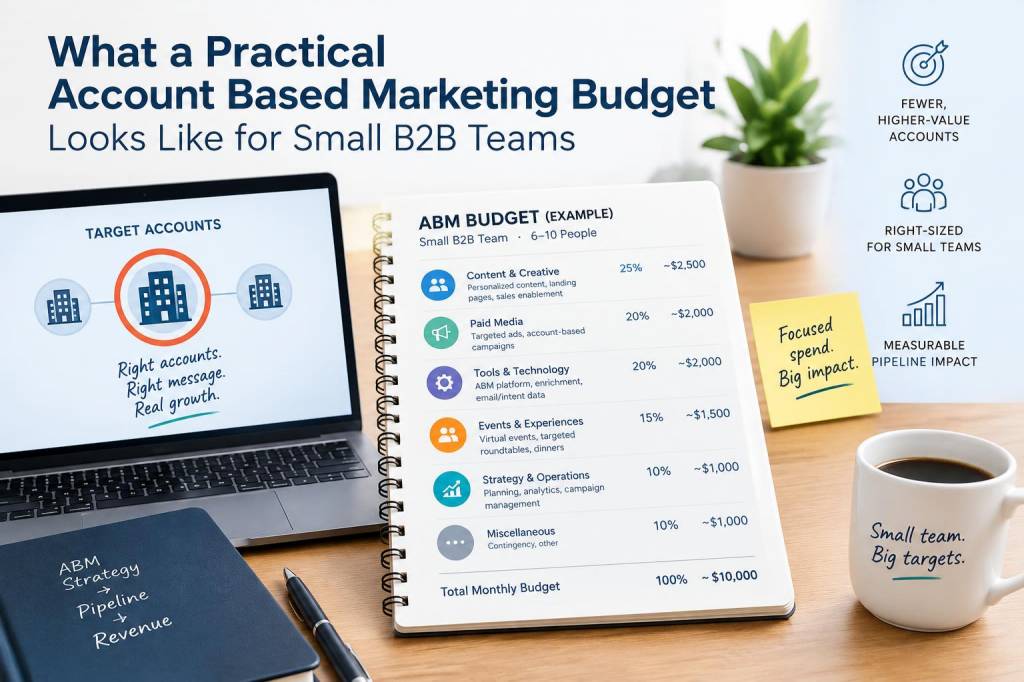
When I build a budget, I like a structure that is simple enough to manage and flexible enough to adapt. For a small team, this is often close to what I use:
- 25 percent for data, account selection, and research
- 25 percent for content, design, and messaging
- 20 percent for paid media and retargeting
- 15 percent for tools and technology
- 10 percent for sales enablement and direct outreach
- 5 percent for testing, learning, and contingency
That split reflects a simple truth: small teams need precision more than volume. I would rather invest in sharper targeting and stronger execution than spread money across too many channels. If my team already has strong tools, I may reduce technology spend and shift more into content or media. If we rely on a lean internal team, I may increase the budget for support services or freelance design.
Tools are useful, but I do not let them consume the budget
It is easy to overspend on software because every platform promises better targeting, richer insights, and easier automation. I respect tools, but I do not let them eat the budget. A small team does not need a complicated stack just to say it does ABM. I want software that helps me identify accounts, enrich data, coordinate outreach, and measure activity without creating more operational drag than value.
Some teams use platforms like HubSpot, Salesforce, 6sense, Demandbase, or Terminus, depending on stack and maturity. I care less about the logo and more about whether the tool supports execution. If a platform is expensive but only used for one feature, that spend is not practical. I prefer a lean setup that leaves room for actual campaign work.
What I cut first when money is tight
When the budget is under pressure, I do not cut targeting or measurement first. I cut vanity activity. That may mean reducing broad awareness spend, trimming low-value content production, or pausing anything that does not connect clearly to target accounts. I also avoid over-customisation when the account value does not justify it. Not every account needs a bespoke experience.
If I have to tighten spending, I usually protect these areas first:
- Account research and segmentation
- Core messaging and value proposition work
- Sales and marketing coordination
- Measurement of account engagement and pipeline influence
What I can reduce more safely is experimental spend that does not yet show clear traction. That might include niche channels, expensive one-off creative projects, or broad paid campaigns that are not matched to account lists.
What I measure so I know the budget is working
A practical ABM budget is one I can defend with results. I do not just watch impressions or clicks. I look at account engagement, meetings created, pipeline generated, deal progression, and the relationship between spend and revenue outcomes. I also watch whether sales and marketing are using the same account list and whether that list is moving in the right direction.
Some of the signals I care about most are:
- Number of target accounts showing meaningful engagement
- Increase in meetings with decision makers
- Progression of accounts from awareness to active opportunity
- Pipeline value influenced by ABM activity
- Conversion rate from engaged account to qualified opportunity
I find that small teams get more value from a few clear metrics than from a dashboard full of noise. If I cannot explain what moved, why it moved, and what we will do next, then the budget is not being used well enough.
My rule for making a small budget feel bigger
The smartest thing I do with a limited ABM budget is align every pound with a specific account problem. When I know exactly which accounts matter, what those accounts care about, and what action I want next, I can make a modest budget perform far better than a large unfocused one. I also keep my planning close to sales, because small teams win when marketing and commercial teams act like one unit.
I do not chase sophistication for its own sake. I build for relevance, repetition, and timing. That is what makes an ABM budget practical. It is not about having every channel or every tool. It is about choosing the right mix, keeping execution realistic, and leaving enough space to learn from what the market actually responds to.