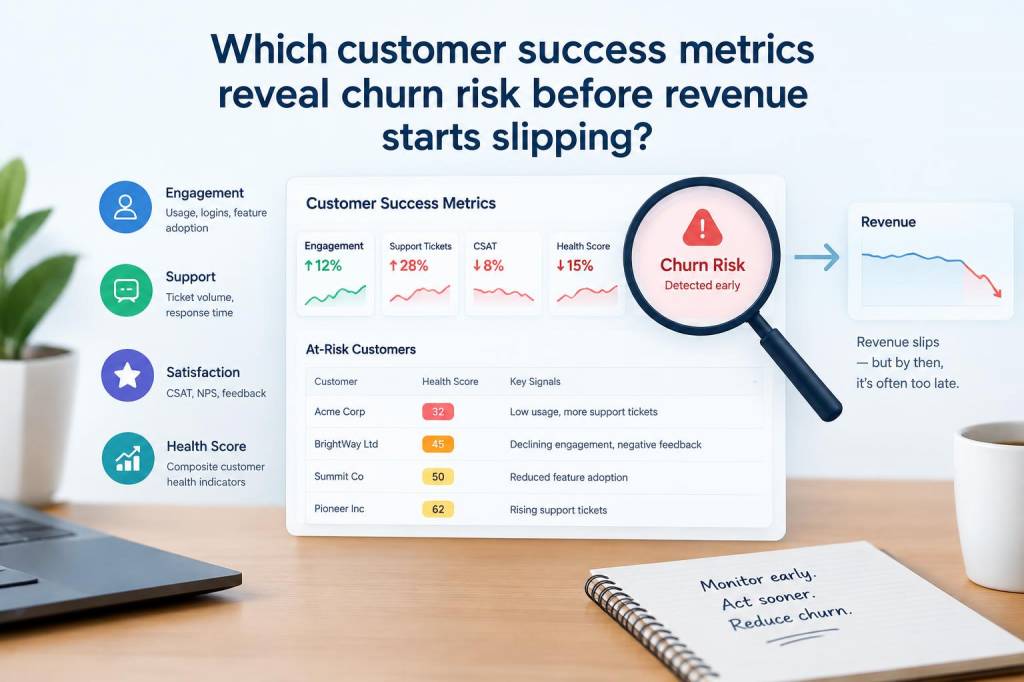
I have learned that churn rarely arrives with a dramatic warning sign. In most cases, it starts as a quiet pattern: a customer logs in less often, a champion disappears, a support issue takes longer to resolve, and a renewal suddenly feels less certain even though revenue still looks stable. That is why I never wait for revenue to tell me a customer is at risk. By the time monthly recurring revenue begins to slip, I have already missed several chances to intervene.
When I look for churn risk early, I focus on customer success metrics that show behavioral change, not just financial change. Revenue is important, but it is a lagging signal. I want metrics that help me answer a more useful question: is the customer still getting value, and do they still believe that value is worth paying for?
Usage trends usually speak before account owners do
The first metric I watch is product usage frequency. If a customer used to log in daily and now only appears once a week, I see that as a warning, even if the contract is still active. A drop in usage is often the earliest sign that the product is no longer part of their routine. That matters because tools that are not used rarely become tools that are renewed.
I also pay attention to breadth of usage. One active user inside a company is not the same as multiple active users across teams. If engagement narrows to a single person, the account becomes fragile. If that person leaves, changes roles, or loses interest, the customer may lose momentum overnight. Broad adoption usually means the product has become embedded in the business, while narrow adoption signals dependency on one advocate.
Another metric that helps me spot churn risk is feature adoption depth. A customer may use the product often, but only for one narrow function. When I see that pattern, I ask myself whether they understand the full value of the platform. Low feature expansion can mean the account has never reached a strong return on investment. In that situation, the customer may not feel enough pain to cancel immediately, but they may still hesitate to renew or expand.
Activation quality matters more than activation speed alone
I used to think that a fast onboarding process was enough. Now I know that speed without depth can create false confidence. A customer may complete setup quickly and still fail to reach meaningful value. That is why I look closely at time to first value and time to repeat value. If customers reach an initial win but never return to the product in a meaningful way, that is a sign that onboarding created curiosity rather than habit.
I also track activation milestones. These are the moments when a customer crosses from setup into real use. If customers stall before reaching those milestones, churn risk rises. In my experience, the strongest accounts are not just those that sign up quickly, but those that complete the right actions early, build a workflow, and experience a clear business result. A customer who reaches value once but cannot repeat it is still at risk.
This is why I care about cohort behavior. If one group consistently activates and another group consistently stalls, I know the issue is not random. It may be a mismatch in messaging, onboarding, implementation support, or customer profile. Churn prevention becomes much easier when I can identify which customers are not moving beyond setup into habit.
Support patterns often reveal hidden frustration
Support data is one of my favorite early warning systems. A customer may still renew today while quietly accumulating frustration that will turn into churn later. I look at ticket volume, ticket recurrence, and ticket severity. A sudden increase in support tickets can mean the product is harder to use than expected. Repeated tickets about the same issue often point to unresolved confusion, which can be more dangerous than a single complaint.
Response time also matters, but not in isolation. A quick reply is useful only if it actually reduces friction. I have seen accounts with fast support but weak resolution quality still drift toward churn. The key question is whether the customer leaves support interactions feeling more confident or more discouraged. If they need help with the same process again and again, they may already be losing trust.
I also watch for escalation behavior. When a customer who once worked directly with an account manager starts bypassing usual channels to ask for urgent help, I take that seriously. Escalation may indicate that the relationship is strained, the internal champion is under pressure, or the product is creating operational risk. In each case, churn can arrive before the revenue report shows any damage.
Relationship health is a metric, not a feeling
Many teams talk about relationships in vague terms, but I prefer to measure them. I want to know whether I still have access to the right people, whether conversations are strategic or purely reactive, and whether the account still has a visible sponsor. Champion health is one of the most important signals I monitor. If my main champion stops attending meetings, takes longer to answer messages, or becomes less enthusiastic about outcomes, I assume the account needs attention.
I also track stakeholder coverage. A healthy account usually has more than one supporter. If all the trust sits with a single contact, the account is vulnerable. People change roles, priorities shift, and budgets get reviewed. When I see low stakeholder coverage, I treat it as a structural churn risk, not just a relationship issue.
Engagement quality during check-ins is another subtle but powerful signal. If meetings become shorter, less detailed, or less focused on results, I assume the customer is mentally disengaging. That does not always mean they are about to leave, but it usually means I need to reintroduce value, update the success plan, or bring in a more relevant use case.
Business outcome metrics are stronger than vanity metrics
I do not trust activity metrics alone. A customer can be active and still unhappy. That is why I try to connect usage with business outcome metrics. For example, if a customer adopted a workflow tool, I want to see whether turnaround time improved. If they use analytics software, I want to know whether decision speed or reporting accuracy improved. If I cannot link product use to measurable business value, then churn risk is harder to see and easier to underestimate.
This is also where renewal readiness becomes useful. I ask myself whether the customer could easily explain the value they received if a finance leader requested proof. If the answer is no, that account may be exposed. Customers renew more confidently when they can point to outcomes, not just features.
I often build a simple view of the relationship between value and risk. The following table shows how I think about it in practice:
| Signal | What I notice | Churn meaning |
|---|---|---|
| Product usage frequency | Logins and activity are declining | Product is losing habit value |
| Breadth of usage | Fewer users are active | Account depends on too few people |
| Feature adoption depth | Customers use only one function | Perceived value may be too narrow |
| Support recurrence | Same issues keep returning | Frustration is accumulating |
| Champion health | Main contact is less engaged | Relationship risk is rising |
| Outcome realization | Business results are unclear | Renewal case is weak |
Net revenue retention tells a story, but not soon enough
Net revenue retention is useful because it shows whether accounts expand, contract, or stay stable over time. Still, I do not rely on it alone to predict churn risk. It is a summary metric, not an early sensor. By the time net retention falls, I have usually seen weeks or months of weaker behavior already.
What I prefer is a layered approach. I look at usage, adoption, support, relationships, and outcomes together. If two or three of those signals weaken at the same time, I know I am not dealing with noise. I am dealing with a customer who is drifting away from value. That is when I move quickly, because early action is much easier than recovery after the renewal date starts approaching.
One thing I have found especially useful is building account health around change over time rather than fixed thresholds. A customer does not become risky just because they have low usage; they become risky when usage falls from their own normal pattern. That is why trend lines are more helpful than snapshots. A healthy account can still have a quiet week. A declining account has a story, and I want to read it before revenue starts to disappear.
What I ask myself when I review a risky account
Whenever I feel an account slipping, I ask a set of questions that helps me separate temporary noise from real churn risk:
- Has usage declined across more than one user or team?
- Are customers still reaching meaningful value, or only completing basic tasks?
- Are support requests increasing in volume or repeating in pattern?
- Has my champion stopped showing the same level of energy?
- Can I clearly connect product activity to business outcomes?
- Would a finance stakeholder understand why this account should renew?
These questions help me move from intuition to action. I do not need every metric to turn red before I respond. In fact, waiting for that usually means I have waited too long. The strongest customer success teams I have worked with are not the ones that can explain churn after it happens. They are the ones that can see it forming early and act while there is still time to change the outcome.
When I use customer success metrics well, I am not just measuring health. I am reading momentum. And momentum is often what separates a loyal account from one that quietly prepares to leave long before revenue starts slipping.